
Why optimistic UI matters in no-code apps
Optimistic UI is the pattern where the interface updates immediately—before the server confirms the change—then reconciles later if the server responds differently. Users experience instant feedback (the app feels “fast”), and you still keep your source of truth on the backend.
This is straightforward in code-heavy stacks, but in no-code and visual development tools it often becomes messy: duplicate writes, race conditions, and “ghost” items in lists when an API call fails. A deterministic pattern solves that by defining a single, repeatable lifecycle for every mutation (create/update/delete) and by making reconciliation an explicit state machine rather than a handful of ad-hoc UI tweaks.
The core idea: one mutation lifecycle, two representations
To make optimistic UI reliable, separate the notion of what the user sees from what the server has confirmed. Your app maintains:
- Optimistic state: what the UI renders immediately.
- Confirmed state: what the backend has acknowledged.
- Mutation log: a deterministic list of pending operations that can be replayed or rolled back.
When you do this consistently, you get fast interactions without “double-writes,” because the server write happens once, and the UI update is a local projection that is later reconciled.
A deterministic pattern that avoids double-writes
The most common failure in no-code optimistic UI is writing twice: once to “make the UI update” and again when the server returns. The deterministic pattern below prevents that by using client-generated identifiers and an explicit reconciliation step.
1) Assign a client mutation ID and (if needed) a client record ID
Every user action that changes data gets a mutationId (a UUID or timestamp-based unique value). For creates, also assign a clientId for the record so the UI can render it immediately.
- mutationId identifies the operation for idempotency and debugging.
- clientId identifies the optimistic record before the server returns a real ID.
In a visual platform like weweb.io, this usually maps to generating values in a workflow step (or a custom JS snippet if needed), then storing them in a local state object.
2) Apply an optimistic patch locally
Instead of “writing to the database” to make the UI change, apply a local patch to your optimistic state:
- Create: insert a new item with
id = clientIdandstatus = pending. - Update: apply the field changes immediately and mark the item
status = pending. - Delete: remove it from the UI or mark it
status = deleting(useful when undo is supported).
The UI should clearly reflect pending state: subtle loading indicator, disabled repeat actions, and a consistent “retry” affordance when something fails.
3) Enqueue the mutation in a log (do not send duplicates)
Add an entry to a mutation log in local state:
mutationId,type(create/update/delete)targetId(clientId for new records, serverId for existing)payload(the data you intend to persist)createdAt,attempts,state(queued/sent/acked/failed)
The log is what makes the system deterministic: it becomes the single list of “things not yet confirmed by the server.” Your UI is just the confirmed state plus the replay of these patches.
4) Send the mutation once, with idempotency
Dispatch the API call using the log entry. The key is to ensure the server treats repeats as safe:
- Include
mutationIdin the request. - If your backend supports it, use an idempotency key or store processed mutation IDs.
This matters in no-code because retries can happen implicitly: users double-click, the app replays a workflow, or a network timeout triggers a retry. With idempotency, a repeated request doesn’t become a second write.
5) Reconcile deterministically: match by mutationId and map IDs
When the server responds, reconcile in a single place:
- Find the log entry by
mutationId. - Mark it
acked(or remove it). - For creates, map
clientIdtoserverIdand update references in the UI state. - Replace any server-authoritative fields (timestamps, computed totals, permissions) from the response.
This is where many apps accidentally double-write: they “create” optimistically, then “create again” when the server returns. The correct behavior is replace (or re-key) the existing optimistic item using the ID mapping, not insert a second item.
6) On error: rollback or compensate, then keep the log consistent
Errors should not leave the UI in an ambiguous state. Choose one of two approaches per mutation type:
- Rollback: revert the optimistic patch to the last confirmed state (best for simple edits).
- Compensate: keep the item visible but mark it failed and allow retry (best for creates, offline, or when losing user input is costly).
Either way, the mutation log entry becomes failed with an error message. The user can retry, which re-sends the same mutationId if the server supports true idempotency, or generates a new one if your backend requires it.
Handling ordering, concurrency, and list flicker
Optimistic UI breaks down when multiple operations overlap. Deterministic reconciliation prevents that by defining ordering rules:
- Per-record serialization: for a given record, apply updates in the order they were queued.
- Conflict policy: if the server returns a newer version than the optimistic projection, either accept server truth or reapply remaining optimistic mutations on top.
- Stable list keys: use
clientIdas a temporary key and re-key toserverIdafter create acknowledgment to prevent flicker.
If you’re building collaborative or multi-actor flows, consider a “version” or “updatedAt” field and reject stale updates server-side, then surface a UI prompt to refresh and reapply. The same discipline used in reconciling financial ledgers—like tracking adjustments and resolving mismatches—maps well here, even if your domain isn’t finance. (The accounting mindset is similar to what’s described when reconciling refunds and credits to fix negative spend in channel ROI.)
How this maps cleanly to no-code workflows
You don’t need a custom client framework to implement the pattern. In practice, you define a small set of reusable building blocks:
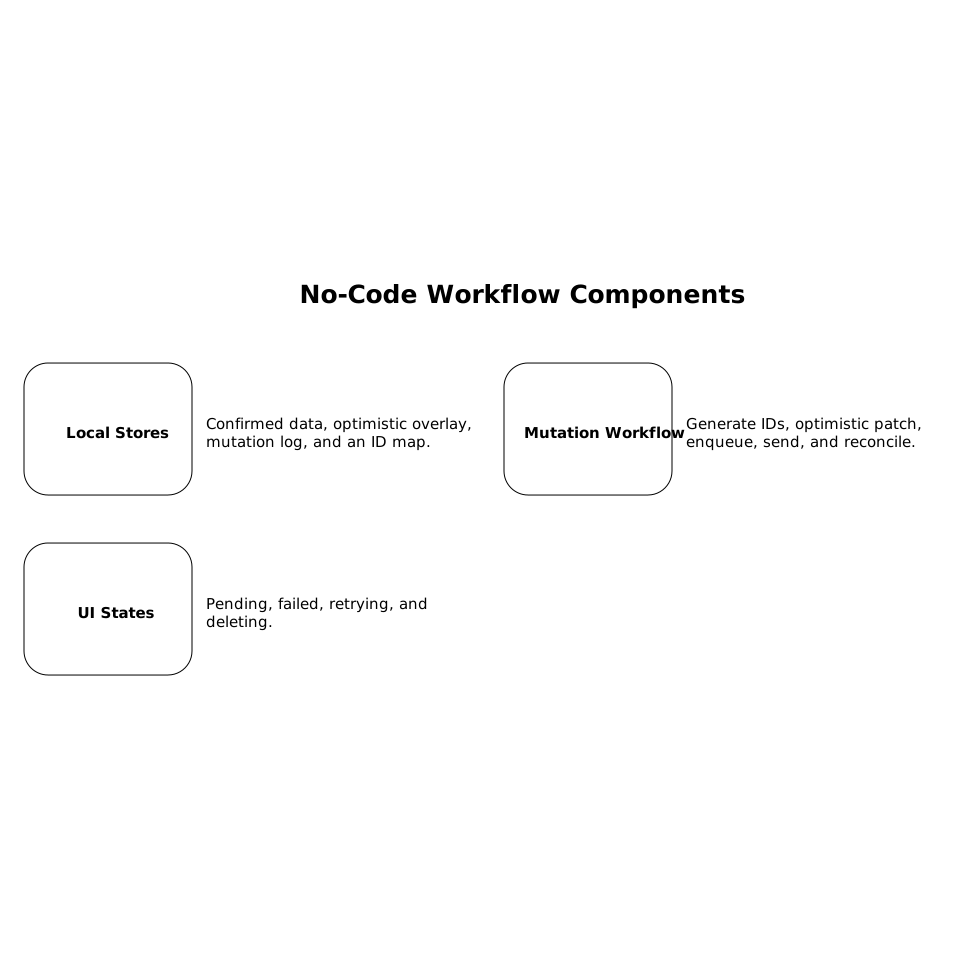
- Local stores: confirmed data, optimistic overlay, mutation log, and an ID map.
- Mutation workflow: generate IDs → optimistic patch → enqueue → send → reconcile.
- UI states: pending, failed, retrying, deleting.
WeWeb’s visual logic and data integrations make this approach approachable because you can keep the lifecycle steps explicit and centralized, rather than embedding “quick UI fixes” into every component. That’s also where teams tend to improve trust: users can see when something is pending or failed instead of guessing. The same product principle shows up in enterprise UX patterns like role-based visibility that builds trust, and it applies directly to optimistic UI status surfaces.
A practical checklist before you ship
- Every mutation has a mutationId; creates also have a clientId.
- The UI renders from confirmed state + replayed optimistic patches.
- No “insert on response” behavior for creates—only re-key and replace.
- Retries do not cause duplicate writes (server idempotency or safe dedupe).
- Errors produce a deterministic state: rollback or compensate, plus a clear retry path.
- List keys remain stable to avoid flicker during reconciliation.